Non-Magnetic
Magnetically sensitive applications require motion systems that are compatible with a defined magnetic environment. In practice, there are two primary requirements: positioners that must not generate a magnetic field, and positioners that must remain unaffected by external magnetic fields, which means using low-permeability materials. Both conditions need to be clearly specified, as they directly affect measurement accuracy, imaging quality, and overall system performance.
Magnetic permeability is a measure of how a material responds to a magnetic field. Materials with a relative permeability near 1 are generally considered non-magnetic because they neither concentrate nor distort magnetic fields. For example, aluminum has a relative permeability of approximately 1.000022, making it nearly invisible to magnetic fields, while soft iron has a relative permeability of 200-5000, which can strongly influence sensitive magnetic environments. Careful material selection, component sourcing, and assembly ensure the system meets the necessary permeability requirements.
Piezo Motor Technology, Intrinsically Non-Magnetic
Micronix piezo-based stages are the foundation for non-magnetic applications. Unlike electromagnetic motors, piezo elements operate through solid-state deformation rather than magnetic fields or current-driven coils. This means the motors themselves produce no magnetic field and are unaffected by external magnetic influences.
To support demanding applications, Micronix positioners are constructed using low-permeability, non-magnetic materials throughout. This allows the stage to deliver precise, repeatable motion while operating near sensitive magnetic equipment.
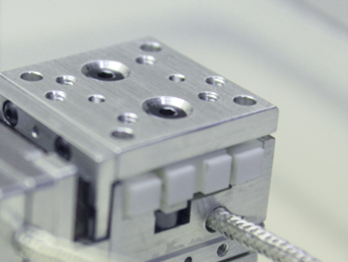
Micronix PPS-20 non-magnetic configuration with ceramic bearings
Materials Used in Non-Magnetic Configurations
Non-magnetic PPS stages achieve their performance through carefully selected materials, including:
These materials maintain strength, precision, and durability, resulting in compact PPS stages ideal for applications with strict magnetic requirements.
|
Material |
Approx. Relative Permeability (μr) |
Notes |
|
Aluminum |
1.000022 |
Lightweight, standard choice for structures |
|
Ceramic |
~1 |
Stable under load |
|
Titanium |
1.0002 |
Stronger, heavier, more costly compared to aluminum |
|
Brass |
1.0002 |
Corrosion-resistant |
|
Stainless Steel (austenitic, e.g., 316) |
1.00002 – 1.05 |
Low permeability if annealed; may be slightly magnetic depending on alloy |
|
Silver (braided cable jackets) |
~1 |
Flexible |
|
Glass |
1 |
Dimensionally stable |
Chart: Material selection is determined in collaboration with engineering, where application requirements are assessed to ensure appropriate choices for both composition and magnetic permeability.